AlphaBitLab · Bitcoin market update
Bitcoin's Liquidity Paradox: More Bank Reserves, Less Crypto Cash
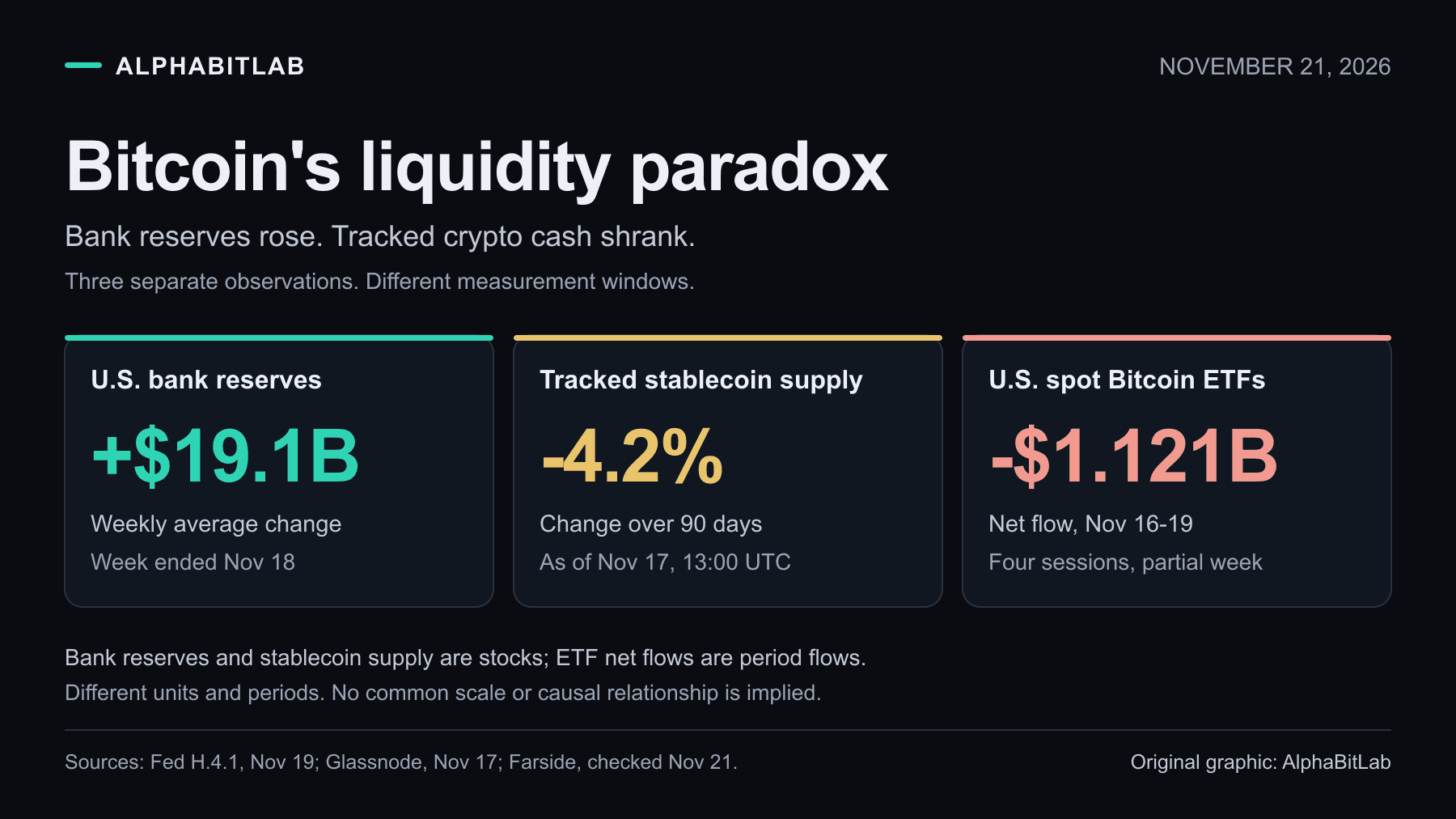
U.S. bank reserves rose $19.1 billion in the latest weekly average. Stablecoin supply fell 4.2% over 90 days. Bitcoin's next test is whether available capital becomes actual buying demand.
01Liquidity has several layers
A weekly rise in U.S. bank reserves coexists with shrinking tracked stablecoin supply over 90 days. Neither series measures total global liquidity.
02Demand remains the test
Completed November 16 to 19 ETF sessions show $1.1208 billion in net withdrawals. Friday is excluded because IBIT remained unreported.
03Valuation and timing differ
The owner-reported November 21 Risk Score is 2.0/10, Undervalued. Further losses remain possible while demand is weak.
Owner-reported November 21 context
- Observation
- Reported
- Weekly change
- Not verified
The owner supplied a 2.0 reading for today's article on November 21. It was not independently captured from the signed-in product. This fixed snapshot does not update; no comparable prior reading or score change is asserted. The signed-out product displays delayed data.
Explore the BTC Risk Model ↗The cash split hiding behind Bitcoin's headlines
Weekly average U.S. bank reserve balances rose $19.053 billion in the week ended November 18. Inside crypto, tracked stablecoin supply had contracted 4.2% over 90 days, according to Glassnode's November 17 report. Federal Reserve, published November 19. Glassnode, published November 17.
These figures measure different things over different periods. Their divergence exposes the question behind Bitcoin's next market shift: how much of the money available in the financial system is actually willing to buy Bitcoin?
Today's opportunity sits in that gap. Exchange withdrawals offer a potentially constructive development, and AlphaBitLab's owner-reported Risk Score is in its Undervalued band. Yet investment-product demand remains weak. A promising valuation backdrop can arrive before a durable recovery.
More bank reserves do not announce a policy pivot
The Fed's November 19 release puts average bank reserves at $2.980 trillion, higher than the previous week even as Reserve Bank credit declined. Reserve balances can rise when other balance-sheet liabilities change. This is a comparison of weekly average stocks, not a discrete $19 billion stimulus injection. Federal Reserve, November 19.
The New York Fed's operating schedule makes the distinction concrete. For November 16 through December 11, it plans approximately $14 billion in reinvestment purchases and no reserve-management purchases. Reinvestment replaces principal payments from existing holdings. The schedule does not announce a new $14 billion easing package. New York Fed, current schedule checked November 21.
Bitcoin's transmission mechanism has several steps: functioning funding markets, investor appetite for risk, then actual purchases. A rise in reserves does not establish improvement at every step. Nor does a U.S. reserve observation measure total global liquidity.
Crypto cash has a competitor that pays
Glassnode reported that three-month Treasury yields had risen approximately 45 basis points over 90 days, alongside the contraction in stablecoin supply. Its data cutoff was November 17 at 13:00 UTC. Glassnode, November 17.
Higher short-term government yields increase the opportunity cost of holding a conventional non-yielding stablecoin. That is a plausible source of competition for capital, not proof that every redeemed token funded a Treasury purchase. Stablecoins also serve payments, collateral and other uses.
For Bitcoin, the implication is narrower and more useful: a shrinking stablecoin pool offers weaker evidence of expanding crypto-native buying capacity. Stabilizing yields and renewed stablecoin growth would improve that backdrop. Actual spot demand would then show whether the additional capacity was being used.
The ETF numbers put the recovery story on trial
Farside's complete November 16 to 19 sessions total $1,120.8 million in net U.S. spot Bitcoin ETF outflows. Monday's $7.9 million inflow gave way to withdrawals of $239.9 million, $306.5 million and $582.3 million. This is AlphaBitLab's calculation from the four daily totals. Farside Investors, live table checked November 21.
One channel of demand
U.S. Bitcoin ETFs · net flow, US$ millions
| Trading date | Net flow |
|---|---|
| November 16, 2026 | 7.9 |
| November 17, 2026 | -239.9 |
| November 18, 2026 | -306.5 |
| November 19, 2026 | -582.3 |
| Subtotal | -1120.8 |
November 20 is excluded. IBIT was still unreported in the source. A missing entry is not zero, and the available subtotal cannot establish the full week's result.
ETF flows capture one important investment channel, rather than all institutional or worldwide demand. Nevertheless, three progressively larger withdrawals following a small inflow give little support to a claim that product demand has decisively returned. Repeated inflows across several sessions and funds would make a recovery case more persuasive.
Coins are leaving exchanges. Their destination still matters.
In a November 21 CryptoQuant community analysis, CoinNiel reported approximately 14,004 BTC in net exchange outflows over the seven days through November 20 UTC, reversing roughly 7,754 BTC in net inflows over the preceding seven days. Withdrawals exceeded deposits across tracked exchanges. CoinNiel on CryptoQuant, published November 21.
That shift is potentially constructive, but it does not prove coordinated whale buying. Withdrawals can reflect custody transfers and wallet reorganizations; measured reserves also depend on address labels. CryptoQuant's November 19 guide explains why location changes require more context before becoming a demand claim. CryptoQuant, published November 19.
CoinNiel also reported dollar-denominated open interest down 14.6% from November 13 to $19.71 billion on November 20, while aggregate funding remained positive. Bitcoin's falling price mechanically reduces dollar open interest, so this cannot all be assigned to contracts closing. Positive funding means longs continued paying shorts. CoinNiel on CryptoQuant, November 21.
Our interpretation: net withdrawals and a lower dollar value of outstanding positions create an opening to monitor. The stronger test is whether sustained buying absorbs supply without a rapid return of expensive, crowded leverage.
The price of money still challenges the bullish case
October CPI rose 0.4% month over month, slower than September's 0.6%. Core CPI increased 0.3%, matching its August and September pace. Most October annual comparisons are unavailable because BLS did not collect the corresponding October 2025 observations during the shutdown. BLS, published November 10.
Slower headline inflation offers some relief. Unchanged core momentum leaves the policy challenge intact. The October Fed minutes, released November 18, showed almost all participants thought further rate increases would probably be appropriate under their baseline outlooks. The target range remains 3.75% to 4.00%. These were October assessments, not a predetermined December decision. Federal Reserve, published November 18.
The global backdrop also resists a simple coordinated-easing story. On October 29, the ECB held its deposit rate at 2.50% and continued portfolio runoff without reinvesting maturing principal. On October 30, the Bank of Japan held its overnight rate around 1.25% and announced faster sales of Japanese stock ETFs beginning January 2027. Those are domestic equity holdings, not Bitcoin funds. ECB, October 29. Bank of Japan, October 30.
For Bitcoin, our inference is that available funding and its cost can pull in different directions. Higher yields can keep competing for capital even when banking-system liquidity looks comfortable.
What a 2.0 Risk Score adds to this setup
AlphaBitLab's owner-reported Bitcoin Risk Score for November 21 is 2.0/10, placing it in the model's Undervalued band. The owner supplied this dated observation for the article; it was not independently captured from the signed-in product. No prior comparison is asserted.
The proprietary score provides a separate assessment of Bitcoin's risk environment. The public indicators in this report offer external market context. They do not explain or reconstruct the score, and this article does not attribute its reading to any specific headline or metric.
An Undervalued classification can coexist with weak demand and further losses. It describes valuation context rather than establishing when buyers will return. Today's opportunity would become more convincing if persistent demand began confirming that context.
Explore AlphaBitLab's Bitcoin Risk Score, inspect its displayed date and history, and follow whether the market's participation improves alongside the reading. This article's snapshot stays fixed; the product's latest available data follows its existing sign-in rules.
November 25 is the next test of the story
October PCE inflation and the second estimate of third-quarter GDP are scheduled for November 25 at 8:30 a.m. Eastern. The next Fed meeting is December 8 to 9. BEA calendar, updated November 20. Federal Reserve meeting dates.
October PCE and third-quarter GDP second estimate
Wednesday · 8:30 AM Eastern
Official release schedule ↗Improving conditions: softer inflation, stabilizing short-term yields, renewed stablecoin growth and sustained ETF inflows would strengthen the recovery case. Softer inflation is most constructive when it eases policy pressure without exposing a sharp deterioration in growth.
An incomplete recovery: net exchange withdrawals persist, but ETF demand remains weak and rebounds struggle to hold. That would leave a potentially attractive valuation backdrop waiting for a demand catalyst.
Growing risk: exchange net inflows return while funding and open interest rebuild, especially if inflation reinforces tightening expectations. A leveraged rebound without durable spot participation would deserve particular scrutiny.
The distinction worth following now is between money that is available and money that commits. AlphaBitLab's 2.0 reading makes the valuation context worth examining. The next evidence to watch is whether persistent buyers begin closing the gap.
Your next step
See the evidence behind the reading.
Explore the model and its methodology. The latest available chart data follows the product's existing sign-in rules.
Explore the BTC Risk ModelSources & further reading
- Federal Reserve H.4.1, November 19, 2026; weekly averages through November 18
- New York Fed Treasury operations, November 16 to December 11 schedule; checked November 21, 2026
- Glassnode, Capitulation Meets Support, November 17, 2026; cutoff 13:00 UTC
- Farside Investors, U.S. Bitcoin ETF flows; checked November 21, 2026; complete sessions November 16 to 19
- CoinNiel on CryptoQuant, exchange netflows and open interest, November 21, 2026; data through November 20 UTC
- CryptoQuant, How to Read Bitcoin Exchange Reserve, November 19, 2026
- BLS October 2026 CPI summary, released November 10, 2026
- Federal Reserve October 27 to 28 meeting minutes, released November 18, 2026
- ECB monetary policy decision, October 29, 2026
- BEA release calendar, updated November 20, 2026
- Bank of Japan monetary policy statement, October 30, 2026
AlphaBitLab publishes model outputs and research for education. This article is not personalized investment advice. Historical observations and model classifications do not guarantee future results.